Dr. Apaak: Government committed to sustainable financing of Ghana’s universities
Deputy Minister for Education, Dr. Clement Apaak, has reaffirmed the government’s commitment to strengthening Ghana’s higher education system through increased investment, improved access and equity, research support, and partnerships aimed at developing sustainable funding mechanisms for tertiary institutions.
Dr. Apaak, delivering an address on behalf of Vice-President Naana Jane Opoku-Agyemang, said the government recognised education as one of the most strategic investments Ghana could make in its future and was committed to ensuring that Ghanaians had access to quality education.
He was speaking at the inaugural Ghana Higher Education Summit held at the Cedi Conference Centre of the University of Ghana on Wednesday, August 26, 2026.
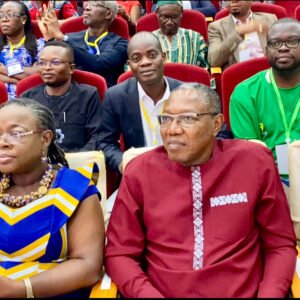
The summit, organised under the theme “Universities at Crossroads: Charting Sustainable Funding Pathways for Inclusive Higher Education,” brought together university leaders, policymakers, researchers, industry representatives, development partners, civil society organisations, alumni and other stakeholders to deliberate on sustainable financing for higher education.
According to Dr. Apaak, Ghana’s universities are facing growing enrolment, increasing expectations for research and innovation, rapid technological change, and rising educational costs against a backdrop of constrained public resources.
He therefore called for a combination of traditional public financing and innovative, collaborative approaches to ensure that universities remain financially resilient while maintaining quality, equity, and academic freedom.
Government outlines higher education interventions
Dr. Apaak said the government had, since assuming office in January 2025, reaffirmed its commitment to strengthening higher education through initiatives designed to promote access, equity, quality, research, and institutional development.
Among the interventions he cited were expanded student loan support, free tertiary education for eligible students with disabilities, investments in public universities, reforms aimed at improving transparency in the National Scholarship Scheme, and investments in university infrastructure.
He also highlighted the operationalisation of the Ghana National Research Fund, supported by an initial GH¢100 million seed funding, to provide competitive research grants and support doctoral and postdoctoral training.
He said the initiatives formed part of the government’s broader vision of building an inclusive, research-driven, resilient, and globally competitive higher education system capable of producing the human capital required to drive Ghana’s socio-economic transformation.
Government alone cannot finance higher education
However, Dr. Apaak acknowledged that public financing alone could not meet the growing demands of the higher education sector.
He called for stronger partnerships among government, universities, industry, development partners, philanthropists, alumni, and the private sector.
“The responsibility for financing higher education can no longer rest solely on government,” he said.
According to him, higher education should be regarded as a shared national asset because its benefits extend beyond university campuses to industries, communities, and the wider economy.
He urged industries to regard universities as partners in innovation and workforce development, while encouraging alumni to view their contributions to their former institutions as investments in future generations.
Development partners, philanthropic organisations and the private sector, he added, could contribute through capacity building, research funding, scholarships, endowments, infrastructure, and innovation initiatives.
Universities urged to become more entrepreneurial
Dr. Apaak also called on universities to explore innovative ways of complementing government funding.
He said universities could commercialise research, expand executive education, strengthen consultancy services and develop entrepreneurial ventures capable of generating additional resources.
However, he stressed that financial sustainability must not undermine inclusivity.
He said every academically capable Ghanaian, irrespective of socio-economic background, should have the opportunity to access quality higher education and realise their full potential.
“The choices we make today will determine whether our universities remain engines of opportunity, innovation, and national transformation for generations to come,” he said.
Apaak backs national conversation
Dr. Apaak commended the University of Ghana for convening the inaugural summit, describing it as an important platform for national dialogue on the future of higher education.
He said the summit had appropriately moved beyond simply identifying challenges to asking three fundamental questions: Who should fund higher education? How should higher education be funded? And where should sustainable sources of funding be found to support teaching, research, innovation, and institutional development?
He expressed confidence that the deliberations would generate ideas and actionable recommendations capable of informing institutional strategies and national policy.
He further urged participants to engage openly and develop practical ideas capable of creating a sustainable and inclusive higher education system in Ghana and beyond.
Aryeetey calls for funding diversification
The call for broader financing partnerships was echoed by Emeritus Professor Ernest Aryeetey, who delivered the keynote address at the summit.
Prof. Aryeetey argued that Ghana’s traditional higher education funding model, which relies heavily on government support and student contributions, was increasingly unsustainable in the face of rising demand and operating costs.
He advocated a diversified financing model involving government funding, performance-based financing, philanthropy, private-sector partnerships, research commercialisation, internally generated funds, and regional collaboration.
He also called for greater private-sector investment in university research, infrastructure, training, and innovation, arguing that industries benefited directly from the skilled graduates and knowledge produced by universities.
Prof. Aryeetey stressed, however, that financing reforms must protect access and equity, particularly for students from low-income households, persons with disabilities, and other disadvantaged groups.
Summit to become annual platform
The Director of the Institutional Advancement Directorate of the University of Ghana, Prof. Gordon Abekah-Nkrumah, explained that the summit emerged from concerns about the increasingly complex challenges confronting Ghana’s higher education institutions.
He said the university conceived the summit as a broad platform for stakeholders to interrogate the challenges facing higher education and develop practical solutions together.
Prof. Abekah-Nkrumah said the immediate focus on financing was prompted by constrained public resources, growing student numbers, and rising costs associated with infrastructure, technology, research, utilities, and institutional operations.
He said the organisers expected the summit to produce practical recommendations, partnerships, and policy proposals while establishing an annual platform for stakeholders to assess progress and continue shaping the future of higher education.
The Vice-Chancellor of the University of Ghana, Prof. Nana Aba Appiah Amfo, in her welcome address, said the summit was intended to initiate an ongoing national conversation on higher education advancement and sustainability.
She noted that universities were increasingly expected to produce leaders, drive innovation, undertake impactful research, and contribute solutions to complex national and global challenges at a time when resources were dwindling.
The inaugural summit, therefore, brought the financing of Ghana’s higher education system to the centre of national discussion, with government, academia, industry, and other stakeholders challenged to work together to build a financially sustainable system without sacrificing access, quality, and inclusivity.
Source:Joseph Wemakor