Prof. Aryeetey calls for radical rethink of university funding as government support proves unsustainable
Emeritus Professor Ernest Aryeetey, former Vice-Chancellor of the University of Ghana, has called for a fundamental rethink of how Ghana’s universities are financed, warning that continued dependence on government funding is increasingly unsustainable.
He said universities must urgently diversify their sources of revenue and embrace innovative financing models capable of supporting teaching, research, infrastructure development, and student welfare without compromising equity and access.
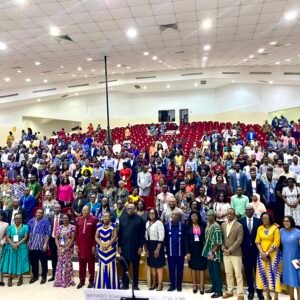
Emeritus Prof. Aryeetey made the call when he delivered the keynote address at the inaugural Ghana Higher Education Summit held at the Cedi Conference Centre of the University of Ghana on Wednesday.
The summit, organised under the theme, “Universities at Crossroads: Charting Sustainable Funding Pathways for Inclusive Higher Education,” brought together university leaders, policymakers, researchers, industry representatives, development partners, alumni, and other stakeholders to deliberate on the future financing of higher education in Ghana.
According to Prof. Aryeetey, the traditional funding model, which relies heavily on government grants and student fees, can no longer adequately respond to the rapidly growing demands on universities.
He said rising student enrolment, increasing costs of infrastructure and technology, expensive research, the need for student support, and growing expectations for universities to drive national development had placed significant pressure on existing funding arrangements.
“Tertiary education, including higher education, is not merely a public service. It is a strategic investment in national development,” he said.
Prof. Aryeetey argued that universities were indispensable to Ghana’s economic and social transformation because they produce the professionals, researchers, entrepreneurs and leaders required to drive development.
However, he noted that universities across Africa were increasingly being expected to “accomplish more with limited resources,” creating what he described as a major challenge for the sector.
Diversification is key
Prof. Aryeetey advocated a diversified funding model that combines government support with performance-based funding, philanthropy, crowdfunding, community support, internally generated revenue and stronger partnerships with the private sector.
He said government financing remained essential, particularly for critical fields such as healthcare, agriculture, engineering, teacher education, and scientific research, but public expenditure should increasingly be linked to measurable outcomes.
He suggested that funding could be tied to indicators including graduation rates, research productivity, graduate employability, innovation, institutional governance, and societal impact.
The former vice-chancellor also urged universities to become more entrepreneurial by generating income from research commercialisation, consultancy services, technology transfer, intellectual property, executive education, short courses, online programmes and industry-based training.
He cited opportunities for universities to utilise their academic expertise and existing resources to generate additional revenue.
Prof. Aryeetey suggested, for instance, that university agricultural units could operate on a larger commercial scale, while departments such as Nutrition and Food Science could expand the production and sale of food products.
He further proposed partnerships between universities and government to revive underutilised productive facilities where proceeds could contribute to internally generated funds.
Private sector must do more
A major concern raised by Prof. Aryeetey was the relatively limited involvement of Ghana’s private sector in financing university education, research, and infrastructure.
He challenged industries to move beyond recruiting graduates and expecting universities to produce skilled workers, arguing that companies must also invest directly in the institutions that produce the human capital and research upon which they depend.
He particularly cited engineering education as an area where private-sector investment could make a significant difference.
“Engineering is one area that private-sector involvement has always been great around the world,” he noted, arguing that Ghanaian universities should develop clearer proposals to demonstrate to industry how such partnerships can generate mutual benefits.
He said structured partnerships could support university infrastructure, research, scholarships, internships, innovation centers, and practical training while simultaneously giving industries access to research, expertise, and skilled graduates.
Protect access and equity
While advocating increased student contributions, Prof. Aryeetey stressed that financing reforms must not exclude students from disadvantaged backgrounds.
He said students should make reasonable contributions towards their education, but the system must be designed around what households can realistically afford.
He called for stronger needs-based scholarships, sustainable student-loan arrangements and income-sensitive financing mechanisms to ensure that financially disadvantaged students, persons with disabilities and students from rural communities were not denied higher education because of their economic circumstances.
“No student with intellectual qualifications ought to be barred from pursuing higher education due to financial limitations,” he stressed.
Stronger financial governance
Prof. Aryeetey also emphasised that sustainability was not only about mobilising additional resources but also about using existing resources effectively.
He called for transparent fiscal planning, stronger financial governance systems, regular audits, performance evaluation, and accountability in the management of both public and private funds.
He further urged policymakers to create legislative and regulatory frameworks that would give universities greater flexibility to determine their growth and transformation strategies according to their individual capacities and ambitions.
He cautioned against treating universities as though they were identical institutions, noting that differences in history, size, capacity, and strategic ambitions must be reflected in public funding and policy.
Summit seeks practical solutions
The inaugural summit was formally opened by the Vice-Chancellor of the University of Ghana, Prof. Nana Aba Appiah Amfo, who said the event was intended to become an ongoing national platform for dialogue on higher education advancement and sustainability.
She said universities were under growing pressure to expand access, strengthen research, drive digital transformation, and contribute to national development at a time when resources were becoming increasingly constrained.
Prof. Amfo said sustainable funding could not be achieved by any single stakeholder and required stronger partnerships among government, universities, industry, philanthropists, alumni, and other actors.
The purpose of the summit was outlined by Prof. Gordon Abekah-Nkrumah, Director of the Institutional Advancement Directorate of the University of Ghana, who said the initiative emerged from growing concerns about the complex challenges confronting higher education institutions.
He said the summit was conceived not merely to identify existing problems but to create an enduring platform where stakeholders could interrogate the challenges, learn from one another, and develop practical solutions.
Prof. Abekah-Nkrumah said the university deliberately chose financing as the starting point because public resources were constrained while the cost of infrastructure, technology, research, utilities, and institutional operations continued to rise.
He said the summit was expected to generate practical recommendations on policy, partnerships, and responsibilities across the higher education ecosystem.
The Special Guest of Honour, Vice President Naana Jane Opoku-Agyemang, in an address delivered on her behalf by the Deputy Minister for Education, Dr. Clement Apaak, similarly called for stronger partnerships between government, universities, industry, development partners, philanthropists, alumni, and the private sector.

The Vice President said the future of Ghana’s universities would depend on diversified funding models that strengthen institutional resilience while preserving academic freedom, quality, equity, and access.
The inaugural summit therefore marked the beginning of what the University of Ghana hopes will become an enduring national conversation on how Ghana can build a financially resilient, inclusive, innovative and globally competitive higher education system.
Source:Joseph Wemakor