Muntaka orders police crackdown on illegal self-protection forces
The Minister for the Interior, Hon. Muntaka Mohammed-Mubarak, has warned chiefs, political parties, individuals, and organisations against forming private security forces, describing such arrangements as illegal under Ghana’s laws.
He has consequently directed the Ghana Police Service to identify and deal with persons and groups engaged in establishing unauthorised forces for self-protection.
“There should be no forces for the protection of any person or group except those authorised by the state,” the Minister stated.
He further charged the Inspector-General of Police (IGP), Mr. Christian Tetteh Yohuno, and regional commanders to “nip this in the bud” and bring perpetrators to book.
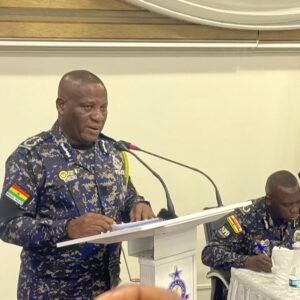
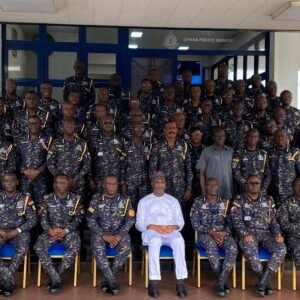
Mr. Muntaka gave the directive on Friday, August 21, 2026, when he opened the Ghana Police Service Regional Commanders’ Conference 2026 at the Police National Headquarters in Accra.
The conference brought together regional commanders, senior police officers, and other stakeholders to deliberate on policing, security, professionalism, and the changing demands on the Ghana Police Service.
Concern over private security forces
The Interior Minister said he was concerned about what he described as a growing trend of chiefs, political parties, individuals, and some organisations building forces for their own protection.
He reminded the Police Service that the Vigilantism and Related Offences Act, 2019 (Act 999) was clear on the issue.
According to him, no individual or group should be allowed to operate a force outside the security institutions authorised by the state.
He therefore tasked police commanders to take the necessary steps to prevent such activities from gaining ground and ensure that those responsible were held accountable.
Police recruits’ videos
Mr. Muntaka also directed police commanders to stop the unauthorised recording and circulation of videos and other content involving recruits undergoing training.
He said he was concerned about the growing practice of officers and trainers at police training schools allowing videos of recruits to be recorded and shared on social media.
The Minister said police training institutions were places of discipline, professionalism, and service and should not become platforms for content that could compromise the privacy, dignity, or security of trainees.
He therefore directed all service commanders to put appropriate controls in place to prevent the unauthorised recording, publication, and circulation of images and videos of recruits.
He stressed that how recruits were treated during training was important because it reflected the standards expected of them when they eventually joined active service.
Government to introduce technology-driven policing
The Minister also disclosed that the government was working with private-sector partners on technology-driven initiatives aimed at improving the efficiency of the Ghana Police Service.
One of the initiatives is an automated system for enforcing road traffic laws and regulations.
According to Mr. Muntaka, the system, being developed in collaboration with the Motor Traffic and Transport Department (MTTD), is expected to be introduced by the end of 2026.
He said government was hopeful that the initiative would contribute significantly to reducing road crashes and fatalities in Ghana.
Another major initiative is the National Criminal Automated Biometric Identification System, being developed in collaboration with the Criminal Investigation Department (CID).
The Minister said government anticipated deploying more than 700 digital enrollment stations across the country by the end of 2026.
He explained that the system would make it possible for background checks to be conducted at locations across the country instead of requiring applicants to travel to Police Headquarters in Accra.
He said the initiative was expected to strengthen intelligence-led policing, improve data accuracy and integrity, fast-track investigations and support early detection of criminal activities.
It is also expected to contribute to the protection of vulnerable groups, improved justice delivery, and greater public confidence in the Police Service.
‘Policy without execution is promise without performance’
Addressing the commanders, the Interior Minister stressed that the government could formulate policies, secure budgets, and advocate for resources, but implementation ultimately depended on police leadership.
“Policy without execution is promise without performance,” he said.
He noted that the Ghana Police Service was the most visible law enforcement arm of the state and that the conduct of police officers could directly influence citizens’ confidence in government and public institutions.
He therefore urged commanders to take responsibility for translating government policies and available resources into effective performance at the regional and operational levels.
IGP calls for a professional and trusted Police Service
For his part, the Inspector-General of Police, Mr. Christian Tetteh Yohunu, said the Police Service was operating at a time when Ghanaians were demanding more from their law enforcement institution.
He said citizens were not asking for perfection but wanted a police service that was present, professional, and capable of preventing crime rather than simply reacting to it.
According to the IGP, Ghanaians also wanted a police service that enforces the law, advances justice, and earns the trust of communities.
“These are not our reasonable demands; they are the minimum standards of a modern police service that we must meet,” he said.
‘Police will not be transformed by speeches.’
Mr. Yohunu said meaningful transformation of the Ghana Police Service would not come simply from conferences, speeches, or directives.
He said the transformation of the institution would depend on the leadership exercised by commanders in their respective commands every day.
“Every decision you make, every standard you set, and every officer you mentor, every case you prioritize, these are the acts that shape the character of this service,” he said.
The IGP said Ghanaians were watching the Police Service “not with hostility but with hope.”
He said citizens wanted a police service they could be proud of—one that protects the weak, pursues the guilty, and serves the innocent.
He further described the desired police service as one that is “visible, approachable, competent, and just.”
Government promises support but demands accountability
The Interior Minister assured the police service that the government would continue to provide support and advocate for the resources needed to improve its operations.
At the same time, he said the government would continue to hold the Service to high standards of accountability, integrity, and professionalism.
He challenged the IGP and regional commanders to approach the conference with open minds and determination, saying the decisions taken and leadership demonstrated after the conference would determine whether the police service could meet the expectations of Ghanaians.
“Ghana deserves a police service it can be proud of. The government of Ghana is committed to building one. The ministry is committed to enabling one,” he said.
The Minister subsequently declared the 2026 Ghana Police Service Regional Commanders’ Conference officially open.
Source: Joseph Kobla Wemakor