ISACA Accra Chapter Calls for Stronger AI Regulation, Corporate Accountability as It Marks 21 Years
The Information Systems Audit and Control Association (ISACA) Accra Chapter has called for stronger corporate accountability, effective regulation of artificial intelligence (AI), and improved digital governance as Ghana deepens its digital transformation agenda.
The call was made at the chapter’s inaugural Founders’ Day Lecture, held on Friday, October 30, 2026, at Wesley Towers in Ridge, Accra, as part of activities marking its 21st anniversary.
The lecture, held under the theme “Who is Really in Charge? Power, Responsibility, and Results in Modern Organizations,” brought together professional leaders and stakeholders to examine the changing relationship between technology, organisational leadership, responsibility, and institutional performance.
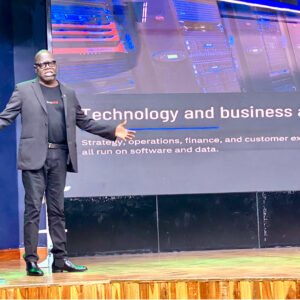
Delivering the keynote address, C.K. Bruce, Founding President of ISACA Accra Chapter, argued that the rapid convergence of business and technology requires a new generation of leaders who understand digital systems, appreciate emerging risks and take responsibility for decisions affecting their organisations.
He maintained that leadership should not be defined by titles or positions of authority but by character, ethical conduct and accountability.
“Leadership is not a title. Leadership is how you behave in certain circumstances,” he stressed, adding that accountability was what distinguished effective leaders from those who merely occupied positions of authority.
Bruce observed that technological advancements, particularly artificial intelligence, cloud computing, and autonomous systems, have fundamentally changed how organisations operate, make decisions, and deliver services.
He cautioned that although AI presents enormous opportunities for productivity, innovation, and organisational efficiency, its growing capabilities also introduce serious security, ethical, and governance concerns that cannot be ignored.
According to him, the emergence of increasingly sophisticated AI agents and autonomous systems makes it imperative for Ghana to strengthen its regulatory and institutional safeguards before the associated risks become difficult to manage.
He noted that Ghana had made progress with its national AI policy but argued that the country needed to move beyond policy development towards comprehensive AI regulation.
“We have an AI policy, not an AI regulation. It is the first step. But we need to move further into AI regulation,” he stated.
He further warned that Ghana’s challenge was not necessarily the absence of laws but inadequate enforcement, pointing to the country’s data protection framework as an example of legislation whose effectiveness depends heavily on implementation.
Bruce called for stronger regulatory institutions equipped with the technical expertise to understand emerging technologies and effectively supervise organisations operating within the country’s growing digital ecosystem.
He also challenged corporate executives to take greater ownership of technology-related decisions rather than leaving critical issues entirely to IT departments.
According to him, business leaders who delegate major technology decisions without understanding their implications effectively surrender part of their authority and expose their organisations to unnecessary risks.
He identified technological literacy, data-driven decision-making, continuous learning, human-centered leadership, ethical conduct and risk management as essential characteristics of effective modern business leadership.
He also cautioned founders against excessive emotional attachment to their organisations, urging them to establish independent and competent governance structures that allow constructive criticism, professional oversight, and accountability.
In corporate culture, Bruce observed that a toxic organisational environment could become a cybersecurity vulnerability when employees lose the motivation to comply with institutional policies and security requirements.
He therefore emphasised the importance of empathy, trust, transparency, and responsible leadership in building resilient organisations.
Bank of Ghana: Boards cannot outsource accountability
Reinforcing the keynote speaker’s position, Kingsley Kpodoh, Assistant Director in the ICT Department responsible for Governance, Risk and Compliance at the Bank of Ghana, delivered a strong regulatory message, insisting that although organisational power is increasingly distributed across technology providers, management teams and artificial intelligence systems, accountability must remain with corporate boards.
Representing the central bank, Kpodoh explained that the traditional understanding of organisational authority had changed considerably.
He illustrated this with the example of a banking application failure, where the immediate technical cause might lie with a cloud service provider operating outside the country, rather than the bank’s managing director.
Similarly, decisions on loan applications could increasingly be influenced by AI models rather than individual credit officers.
However, he stressed that such technological arrangements did not absolve institutional leadership of responsibility.
“Power has become distributed, but responsibility has not. The board is always responsible,” he declared.
He identified board accountability, third-party risk management, and artificial intelligence as three critical areas requiring heightened attention within Ghana’s financial services sector.
Kpodoh said the Bank of Ghana expected boards to exercise effective oversight of technology and cybersecurity risks, rather than concentrating exclusively on financial performance.
He referenced the Bank of Ghana’s Corporate Governance Directive of 2018 and the Cyber and Information Security Directive of 2026, emphasising that accountability could not be outsourced to technology vendors or service providers.
He warned that boards could not claim authority when approving major technology investments and partnerships only to plead ignorance when regulatory scrutiny followed a security breach or operational failure.
“You cannot claim power in the boardroom and plead ignorance in the examination room,” he cautioned.
In third-party risk management, Kpodoh observed that Ghana’s banking sector had become increasingly dependent on external service providers for critical operations, including cloud infrastructure, payment switches, fraud management and other digital services.
While these partnerships have enhanced innovation and operational efficiency, he warned that excessive dependence on a limited number of service providers could expose the financial system to concentration risks.
He disclosed that the central bank’s data indicated that disruption affecting two critical shared service providers could potentially impact more than 60 percent of repayment transactions.
He therefore urged financial institutions to maintain board-approved registers of material third-party providers, including subcontractors, establish effective audit rights, undertake regular due diligence and maintain tested exit strategies.
“If you cannot exit, you are not in an outsourcing engagement. You are in captivity,” he warned.
On artificial intelligence, Kpodoh advocated responsible adoption, insisting that financial institutions must be able to explain, monitor, and control AI-driven decisions.
He called for human oversight in high-impact decisions, proper documentation throughout AI systems’ life cycles and clear institutional ownership of AI-related risks.
“Efficiency without ethics is not innovation. It is a liability,” he stated.
He concluded that while power in modern organisations was shared among boards, management, vendors, and algorithms, accountability must remain firmly anchored at the board level.
ISACA Accra Chapter celebrates 21 years of professional leadership
Earlier, welcoming participants, Solomon H. H. Ackom, a founding member of the ISACA Accra Chapter, recounted the organisation’s beginnings and its remarkable growth over the past two decades.
He disclosed that 11 individuals gathered at Alisa Hotel in Accra on October 5, 2005, to explore the possibility of establishing a local ISACA chapter.
What started as a modest meeting has since developed into a professional institution with approximately 800 members, making it one of Ghana’s leading IT and cybersecurity professional associations.
Ackom attributed the chapter’s achievements to the vision, commitment, and sacrifices of its founding members, past presidents, successive boards, members, and partners.
He highlighted its contributions to national policies and guidelines, banking sector regulation, and the development and governance of emerging technologies.
He also noted that ISACA members continue to play important roles across various institutions, contributing to the security, resilience, and effective governance of Ghana’s information and communications infrastructure.
Ackom used the occasion to highlight the importance of professional capacity development in AI auditing, announcing that ISACA had introduced its Advanced in AI Audit Certification to strengthen professional competence in auditing and providing assurance over artificial intelligence systems.
He said the chapter remained committed to equipping its members with the expertise needed to address emerging technology risks and promote responsible AI adoption.
He described the inaugural Founders’ Day Lecture as more than an anniversary celebration, explaining that it was designed to honour the chapter’s history while creating a platform for meaningful conversations on leadership, technology, and national development.
Call for stronger professional development and industry collaboration
In his closing remarks, Daniel Gyampo, a former President of ISACA Accra Chapter, called for stronger collaboration with universities, professional associations, and other institutions to expand technology education and professional development.
He advocated the integration of ISACA courses into tertiary education programmes to ensure graduates acquire practical competencies that prepare them for the demands of the modern job market.
He further identified training, mentoring and management consulting, particularly in assurance and advisory services, as important areas the chapter intends to strengthen in the coming years.
Gyampo encouraged professionals with relevant expertise to volunteer their services and contribute to the chapter’s broader capacity-building and institutional development agenda.
The inaugural lecture established a new annual platform for reflection on the evolving demands of organisational leadership and professional responsibility.
As Ghana continues to expand its digital economy and embrace emerging technologies, the central message from the event was clear: technological advancement must be matched by effective governance, ethical leadership, competent regulation and institutional accountability.
For ISACA Accra Chapter, the challenge goes beyond helping organisations adopt new technologies. It is also about ensuring that those who exercise power understand the risks, accept responsibility for their decisions and remain answerable for the results.
After 21 years of professional service, the chapter appears determined to position itself at the forefront of that national conversation.
Source:Joseph Kobla Wemakor